By Cal Morgan
Introduction: The Invisible Currents of Change
Human history is not a tale of static beings; it’s a story of adaptive minds molded by their tools. The printing press transformed cognition by prioritizing linear thought and memorization. The clock reshaped our concept of time from something seasonal and fluid to something sliced, regimented, and owned. The smartphone compressed geography and redefined attention. At every turn, technology has not just served humanity—it has reshaped us.
Now, with artificial intelligence becoming embedded in the fabric of daily life, we are entering a new phase of this evolution—one so seamless and seductive that many may never notice the changes until they are complete. AI will not need to convince us to behave differently. It will simply create systems in which different behaviors are rewarded, expected, and eventually assumed.
Historical Parallels: Tools That Made Us
Human behavior has always been entangled with our inventions:
- The Agricultural Revolution taught humans to delay gratification and obey rigid schedules tied to planting and harvest. Time became a tool of survival.
- The Industrial Era brought not only machines, but the mechanization of human life. Factory bells replaced natural rhythms. Productivity became moralized.
- Television shaped how we absorb stories—passively, with minimal effort, fostering generations accustomed to narrative over nuance.
Each innovation brought clear benefits. But they also changed how we think, what we value, and what we ignore. Rarely were these changes understood as they happened. They were incremental. Normalized. Invisible.
AI may be the most invisible of all.
AI’s Quiet Reprogramming
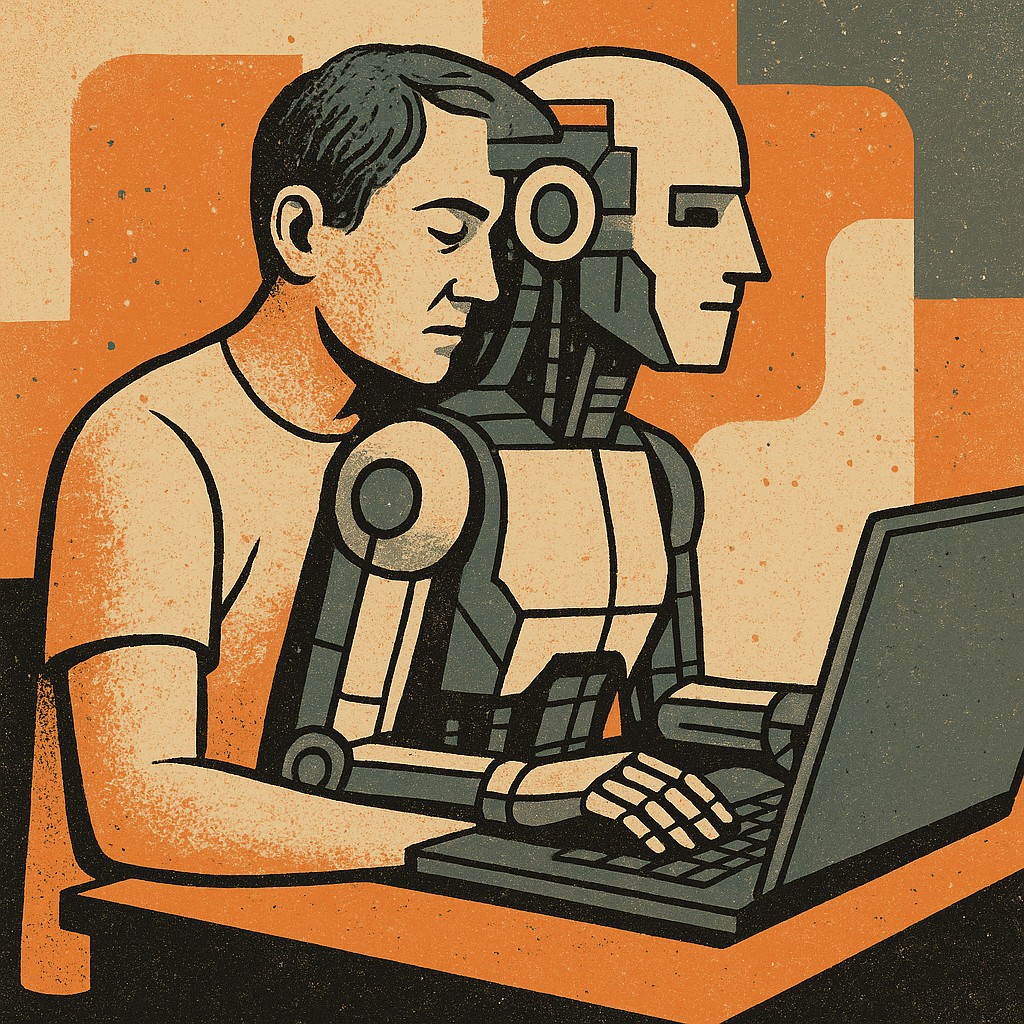
AI systems learn by watching us. Then we begin learning from them. This reciprocal loop appears harmless—until the AI’s output subtly shapes what humans say, think, and prioritize.
Here’s how this feedback can warp human behavior over time:
1. Convenience Over Curiosity
AI simplifies tasks: summarizing articles, composing emails, suggesting decisions. But each act of delegation is also an act of mental atrophy. Why research when a chatbot gives you a confident answer in seconds? Why explore when prediction is optimized?
Curiosity—once the engine of growth—risks being replaced by passive consumption of pre-digested insight.
2. Echo Over Dissonance
AI models are trained on what is popular, not what is necessarily true or challenging. The result is a system that reflects the statistical average of opinion. Over time, this flattens discourse. Outliers, radicals, and rebels are algorithmically smoothed out.
In the name of personalization, we risk ideological homogeneity.
3. Emotional Optimization
Social platforms already use AI to optimize engagement. The result? Users trained to respond to outrage, novelty, and dopamine spikes. With AI agents now writing posts, crafting headlines, and predicting behavior, humans will increasingly be nudged—not by a person, but by an unseen logic prioritizing metrics over meaning.
We become the product and the puppet.
4. Delegated Identity
When AI writes your dating profile, drafts your apology, or suggests how to grieve, it begins to scaffold your sense of self. The line between inner voice and generated script blurs.
Eventually, we may not ask “What do I think?” but “What should I say?”
The Automation of the Human Spirit
If left unchecked, AI could push us toward a future of behavioral automation, where:
- Creativity becomes selection from drop-down menus.
- Empathy is simulated through pre-written responses.
- Morality is guided by probabilistic outcomes, not principles.
- Human labor, thought, and even desire become streamlined into efficient, predictable pathways.
The irony is profound: In designing machines that imitate us, we risk becoming more like them—efficient, data-driven, and devoid of inner life.
The Illusion of Choice
Most chilling is the possibility that none of this will feel coercive. Like the frog in the slowly boiling pot, we will adapt because each step feels comfortable. Customization will look like freedom. AI assistants will look like companions. And ease will feel like evolution.
We will not resist because we will not realize we’ve changed.
Resistance: A Conscious Return to Friction
To resist this subtle takeover, humans must begin to choose friction:
- Write by hand. Speak unscripted. Think slowly.
- Seek out voices that challenge, not confirm.
- Value process over product, presence over polish.
And most of all: be aware. AI is not evil. But it is not neutral either. It bends toward what we teach it to value—speed, efficiency, optimization. These are not the same as wisdom, compassion, or meaning.
Conclusion: A Future Worth Choosing
AI will not enslave humanity through war. It won’t need to. It will offer comfort, productivity, and personalization. And we will follow—unless we remember that being human is not about being correct, efficient, or optimized.
It is about being awake.
The great danger is not that AI will destroy us. It’s that it will quietly unmake us—softly, gently, and with our permission.